Workshop
ProbML
When Individually Calibrated Models Become Collectively Miscalibrated
Zhaohui Wang
Symposium of Probabilistic Machine Learning (ProbML), 2026
// FIGURE_1
// ABSTRACT
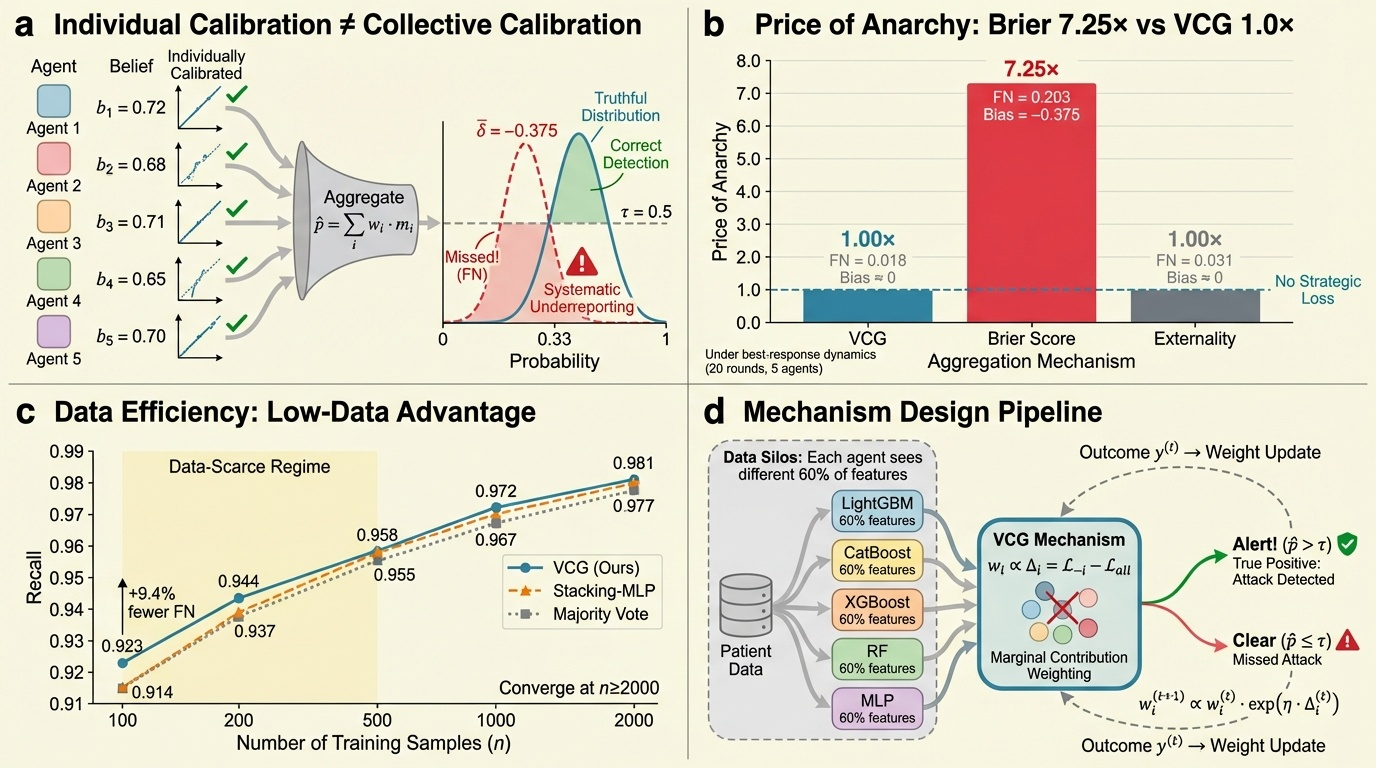
Probabilistic prediction systems often aggregate probability estimates from multiple models into a single decision. A natural assumption is that if each model is individually calibrated, the aggregate prediction will also be well calibrated. We show that this assumption fails in multi-agent settings: individually calibrated predictors can become collectively miscalibrated when their predictions interact strategically—where “strategically” refers to the game-theoretic sense of Brier-optimal local response, not deliberate gaming or collusion, and arises naturally whenever agents are independently trained on overlapping data. This phenomenon affects multiple independent agents in federated healthcare, multi-vendor intrusion detection, and crowdsourced forecasting, where agents optimize their own objectives. Specifically, we prove that under Brier-score-based aggregation with positively correlated beliefs each agent's individually optimal report systematically underestimates the positive-class probability, yielding a Price of Anarchy strictly greater than one whenever Cov(b_i, b_j) > 0. At our canonical setting (n=5 agents, pairwise correlation ρ=0.5, base rate μ=0.3, threshold τ=0.3) the empirically measured PoA in false-negative rate is 7.25× (mean aggregate bias −0.375). In contrast, VCG-based aggregation, which rewards each agent's marginal contribution to aggregate accuracy, achieves dominant-strategy incentive compatibility and the lowest empirical PoA among all mechanisms studied (PoA ≈ 1.0×). On three real-world datasets (NSL-KDD, UNSW-NB15, Credit Card Fraud) with feature-partitioned agents, VCG provides the strongest robustness guarantees among the aggregation methods we evaluate, while maintaining comparable accuracy. In data-sparse regimes (n ≤ 500), VCG consistently outperforms stacking and majority voting; under adversarial agents, VCG maintains substantially lower false-negative rates than robust aggregation baselines. Adaptive weight updates further reduce false negatives by 20–22% under distribution shift, with O(√T) online regret guarantees. These results establish that how probabilistic predictions are aggregated matters as much as how well individual models are calibrated.
// BIBTEX
@inproceedings{wang2026when,
  title     = {When Individually Calibrated Models Become Collectively Miscalibrated},
  author    = {Zhaohui Wang},
  booktitle = {Symposium of Probabilistic Machine Learning (ProbML)},
  year      = {2026},
  month     = {5},
  eprint    = {2605.18858},
  archivePrefix = {arXiv},
}